
Benefits of an LLC
Discover why a Limited Liability Company is America’s most popular business structure — and how it can protect, grow, and simplify your business.

Why LLCs Dominate Small Business
The numbers don’t lie — LLCs are the go-to choice for entrepreneurs across America.
What Makes an LLC Special?
An LLC (Limited Liability Company) is the only business structure that gives you three critical advantages at once:
- Liability protection like a corporation — your personal assets are shielded
- Tax simplicity like a partnership — profits pass through to your personal return
- Operational flexibility like a sole proprietorship — no board meetings, no complex formalities
No other structure offers this combination. Corporations protect you but tax you twice. Sole proprietorships are simple but expose everything you own. An LLC is the sweet spot.
Key Insight: An LLC is not a corporation, nor is it a partnership or sole proprietorship. It is a distinct legal entity that borrows the best features from each — liability protection from corporations, and tax simplicity from partnerships.
Personal Asset Protection
The #1 reason entrepreneurs choose an LLC — and the benefit that could save everything you own.
The “Corporate Veil” Explained
When you form an LLC, you create a legal separation between yourself and your business. The LLC becomes its own legal “person” under the law. This means:
- If your business is sued, plaintiffs can only go after business assets — not your home, car, or savings
- If your business cannot pay its debts, creditors cannot seize your personal property
- If a contract goes wrong, your personal bank accounts remain untouched
This separation is called the “corporate veil” or “liability shield.” It is the single most powerful reason to form an LLC.
Real-World Examples
Here is what liability protection looks like in practice:
- Consultant: A client claims your advice caused financial loss. Without an LLC, they sue you personally. With an LLC, they sue the business — your home and savings are protected.
- E-commerce seller: A customer is injured by a product you sold. Without an LLC, you are personally liable for medical bills and damages. With an LLC, liability is limited to business assets.
- Landlord: A tenant slips and falls, suing for $100,000. Without an LLC, your personal assets are at risk. With an LLC, only the property owned by that LLC is exposed.
- Freelance designer: A copyright infringement claim arises from work you created. Without an LLC, you pay out of pocket. With an LLC, the business bears the burden.
Important Caveat: An LLC protects you from business liabilities, but not everything. It does not protect against personal guarantees on loans, professional malpractice (you still need insurance), criminal acts, or “piercing the veil” if you mix personal and business finances. Always maintain separate bank accounts and proper records.
Tax Flexibility & Savings
An LLC gives you choices — and choices save you money.
Pass-Through Taxation (Default)
By default, an LLC does not pay federal income tax itself. Instead, profits and losses “pass through” directly to the members, who report them on their personal tax returns.
This avoids the double taxation that C corporations face:
- C Corporation: Profits taxed at the corporate level (21%) → then taxed again as dividends to shareholders (up to 20% capital gains)
- LLC (default): Profits pass directly to members → taxed only once on personal returns
For a business earning $100,000 in profit, a C corporation could pay over $35,000 in combined taxes. An LLC member pays only their personal income tax rate — potentially saving thousands.
Choose Your Tax Classification
An LLC’s greatest tax advantage is flexibility. You can elect how the IRS treats your LLC for tax purposes:
- Default (Single-member): Taxed as a sole proprietorship — simple, no separate business tax return
- Default (Multi-member): Taxed as a partnership — profits split among members, each reports their share
- S-Corp Election: Pay yourself a reasonable salary (subject to payroll taxes) and take remaining profits as distributions (not subject to self-employment tax) — can save 15.3% on a portion of income
- C-Corp Election: Taxed as a corporation — useful if you want to retain earnings in the business or offer stock options
You can change your tax classification as your business grows. Start simple, optimize later.
Tax Deductions & Write-Offs
Operating as an LLC unlocks business tax deductions that sole proprietors often miss or cannot fully claim:
- Home office deduction — dedicated workspace in your home
- Vehicle expenses — mileage or actual expenses for business use
- Health insurance premiums — 100% deductible for self-employed individuals
- Retirement contributions — SEP-IRA, Solo 401(k) with higher limits
- Business meals & travel — 50% of meals, 100% of travel
- Equipment & software — Section 179 deduction up to $1.2M
- Qualified Business Income (QBI) deduction — up to 20% of net business income
Pro Tip: The S-Corp election is one of the most powerful tax strategies for profitable LLCs. If your LLC earns $60,000+ in profit, electing S-Corp status could save you thousands in self-employment taxes. Consult a tax professional to see if it makes sense for your situation.
Business Credibility
Perception matters. An LLC signals that you are serious about your business.
Professional Image
“Smith Consulting, LLC” looks more established than “John Smith, Freelancer.” Customers, vendors, and partners take you more seriously when you operate as a formal entity.
Easier Access to Credit
Banks and lenders prefer working with LLCs. You can build business credit separate from your personal credit, opening doors to larger loans and better terms.
Better Vendor Terms
Suppliers and vendors often offer net-30 or net-60 payment terms to LLCs but not to individuals. An LLC signals stability and reduces their risk.
Government Contracts
Many government and corporate contracts require vendors to be formal business entities. An LLC qualifies you for opportunities sole proprietors cannot access.
Platform Requirements
Amazon, Shopify, and many B2B platforms require or strongly prefer sellers to operate as LLCs. It is often a prerequisite for wholesale accounts and brand registry.
Investor Appeal
Investors and venture capitalists rarely invest in sole proprietorships. An LLC structure makes your business “investment-ready” and shows you understand business fundamentals.
Operational Freedom
Run your business your way — no board meetings, no shareholder votes, no red tape.
No Corporate Formalities
Corporations must hold annual shareholder meetings, keep detailed minutes, maintain a board of directors, and follow strict record-keeping rules. LLCs have none of these requirements:
- ❌ No annual shareholder meetings
- ❌ No board of directors
- ❌ No corporate minutes or resolutions
- ❌ No complex bylaws
- ❌ No restrictions on officer roles
You run the business how you see fit, governed only by your Operating Agreement — a document you write yourself.
Minimal Ongoing Requirements
Compared to corporations, LLCs have far lighter ongoing compliance burdens:
- File an annual report (most states) — often just a fee and basic info update
- Maintain a registered agent — can be yourself or a service ($50–$150/year)
- Keep business and personal finances separate — open a business bank account
That is it. No quarterly board meetings, no complex tax filings (by default), no extensive record-keeping.
Management Flexibility
LLCs can be managed in two ways — you choose what works for you:
- Member-managed: All owners (members) participate in day-to-day operations. Ideal for small businesses and partnerships.
- Manager-managed: Members appoint one or more managers to run the business. Ideal when some members are passive investors.
Corporations do not offer this flexibility — they require a rigid hierarchy of shareholders, directors, and officers.
Ownership Flexibility
LLCs welcome almost anyone as an owner — with no arbitrary limits.
Unlimited Members, Unlimited Possibilities
An LLC can have one member or one hundred. There are no limits on the number of owners, and members can be:
- Individuals (US citizens, residents, or non-residents)
- Other LLCs
- Corporations
- Trusts
- Foreign entities and non-US residents
Compare this to S corporations, which are limited to 100 shareholders and cannot have non-US residents, corporations, or LLCs as shareholders. LLCs have no such restrictions.
Customizable Profit Sharing
In a corporation, profits must be distributed according to share ownership. In an LLC, you can split profits however you want — regardless of ownership percentage.
For example, if three members own 33% each but one member does 60% of the work, your Operating Agreement can specify that member receives 60% of profits. This flexibility is unique to LLCs and partnerships.
Perfect for International Entrepreneurs
Non-US residents can form and own a US LLC in any state. There are no citizenship or residency requirements. This makes LLCs the ideal vehicle for:
- Accessing US payment processors (Stripe, PayPal, Square)
- Opening US business bank accounts
- Selling to US customers with credibility
- Operating a US-based business from anywhere in the world
Services like Doola and StartGlobal specialize in helping international founders establish US LLCs.
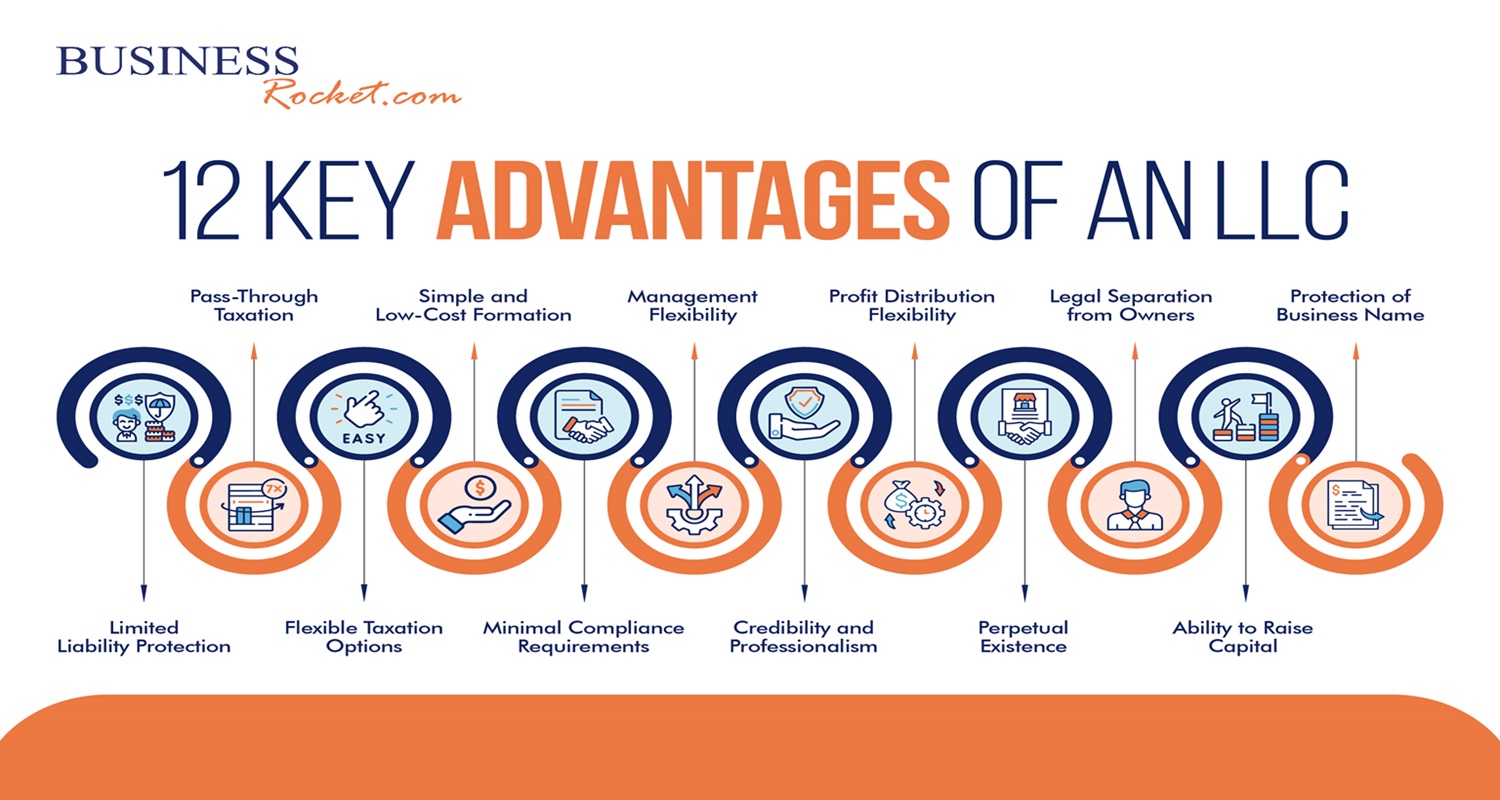
A comprehensive overview of the 12 key advantages an LLC offers over other business structures. Source: BusinessRocket
LLC vs. Other Business Structures
See how an LLC stacks up against every other option.
| Feature | Sole Proprietorship | Partnership | LLC | C Corporation | S Corporation |
|---|---|---|---|---|---|
| Personal Liability Protection | ❌ None | ❌ None | ✅ Yes | ✅ Yes | ✅ Yes |
| Pass-Through Taxation | ✅ Yes | ✅ Yes | ✅ Yes (default) | ❌ Double taxed | ✅ Yes |
| Formal Registration Required | ❌ No | ❌ No | ✅ Yes | ✅ Yes | ✅ Yes |
| Operational Flexibility | ✅ High | ✅ High | ✅ High | ❌ Low (formalities required) | ⚠️ Medium |
| Raising Capital | ❌ Difficult | ❌ Difficult | ⚠️ Moderate | ✅ Easy (sell stock) | ⚠️ Moderate |
| Business Credibility | ❌ Low | ❌ Low | ✅ High | ✅ High | ✅ High |
| Ownership Restrictions | 1 owner only | 2+ partners | Unlimited members | Unlimited shareholders | Max 100 shareholders |
| Tax Classification Options | ❌ None | ❌ None | ✅ 4 choices | ❌ Fixed | ❌ Fixed |
| Annual Compliance Burden | ✅ Minimal | ✅ Minimal | ✅ Low | ❌ High | ⚠️ Medium |
Bottom Line: An LLC offers the best balance of liability protection, tax flexibility, and operational simplicity for most small businesses. It gives you the protection of a corporation without the complexity and formalities.
Who Benefits Most from an LLC?
These business types gain the most from forming an LLC.
Freelancers & Consultants
Protect your personal assets from client disputes, copyright claims, and contract breaches while gaining credibility with high-value clients.
Real Estate Investors
Isolate liability per property. Use separate LLCs to protect your portfolio — if one property is sued, the others remain safe.
E-Commerce Sellers
Amazon FBA, Shopify, and Etsy sellers gain liability protection, platform credibility, and easier access to business banking and credit.
Family Businesses
Pool assets, share management, and transfer ownership to heirs while maintaining liability protection and estate planning benefits.
International Entrepreneurs
No citizenship or residency required. Access US markets, payment processors, and banking from anywhere in the world.
Growing Startups
Start simple with pass-through taxation, then elect S-Corp or C-Corp status as revenue grows — without reincorporating.
Best LLC Formation Services
These services handle the paperwork for you, ensuring your LLC is formed correctly and quickly.

LegalZoom
LegalZoom is one of the most recognized names in online legal services. With extensive experience and millions of customers served, they offer a beginner-friendly platform for LLC formation.
- Established reputation and trust
- Easy online process with guided steps
- Additional legal services available
- Comprehensive customer support

Bizee
Bizee (formerly Incfile) offers a genuinely free Silver package where you pay only state fees. They include a full year of registered agent service and lifetime company alerts at no extra cost.
- Free formation package (state fees only)
- One year of free registered agent service
- Lifetime company compliance alerts
- Fast online filing process

Doola
Doola is built specifically for global entrepreneurs who want to start and run US businesses from anywhere in the world. Their platform combines LLC formation with banking, tax, and compliance tools.
- Global entrepreneur support
- Online business tools
- LLC formation assistance
- Integrated banking & tax tools

Harbor Compliance
Harbor Compliance specializes in entity management and compliance software. They are ideal for businesses that want robust tools to stay compliant with state requirements.
- Advanced compliance software
- Entity management dashboard
- Registered agent service
- License tracking & renewal alerts

Business Rocket
Business Rocket focuses on making business formation and ongoing compliance as simple as possible. Their platform is designed for entrepreneurs who want to stay on top of state requirements.
- Business formation support
- Compliance tracking and alerts
- Entrepreneur-focused solutions
- Ongoing compliance assistance

StartGlobal
StartGlobal specializes in helping non-US founders establish companies in the United States. They understand the unique challenges international entrepreneurs face.
- Support for non-US founders
- US business formation assistance
- Global entrepreneur focus
- International banking guidance
Frequently Asked Questions About LLC Benefits
Personal asset protection is the #1 benefit. An LLC creates a legal separation between you and your business, meaning your home, car, savings, and personal property are generally protected from business debts and lawsuits. For most entrepreneurs, this protection alone justifies the small cost of forming an LLC.
Yes, in several ways. First, LLCs avoid double taxation through pass-through taxation. Second, you can elect S-Corp status to save on self-employment taxes (potentially thousands for profitable businesses). Third, operating as an LLC unlocks business deductions like home office, vehicle expenses, health insurance, and the 20% Qualified Business Income deduction. The tax flexibility alone often pays for the LLC formation cost many times over.
For almost every business, yes. A sole proprietorship offers zero liability protection — your personal assets are fully exposed to business risks. An LLC gives you the same operational simplicity but adds a liability shield, tax flexibility, and business credibility. The only scenario where a sole proprietorship might make sense is a true hobby with no revenue and no customer interaction. The moment money changes hands or liability exists, an LLC is the better choice.
Yes. A single-member LLC is owned by one person and is the most common type of LLC. All states allow single-member LLCs. For tax purposes, the IRS treats a single-member LLC as a “disregarded entity,” meaning it is taxed like a sole proprietorship unless you elect otherwise. You get full liability protection with no added tax complexity.
An LLC helps separate your business and personal credit. Business debts, loans, and credit cards taken out in the LLC’s name typically do not appear on your personal credit report (unless you personally guarantee them). Over time, you can build a business credit profile independent of your personal credit, which protects your personal score and opens doors to larger business financing.
Yes. You can elect to change your LLC’s tax classification by filing IRS Form 8832 (for C-Corp) or Form 2553 (for S-Corp). You are not locked into your initial choice. Many businesses start as default pass-through entities and later elect S-Corp status once revenue justifies the additional paperwork and payroll requirements.
Yes. Online businesses face the same liability risks as brick-and-mortar ones — product liability, copyright infringement, data breaches, chargeback disputes, and customer lawsuits. An LLC protects your personal assets from these risks. Additionally, platforms like Amazon, Shopify, and Stripe often require or strongly prefer sellers to operate as formal business entities. An LLC also makes it easier to open business bank accounts and build business credit.
Ongoing costs are minimal compared to the protection you receive. Typical annual costs include: state annual report fees ($0–$300), registered agent service ($0–$150/year — some services include the first year free), and any optional compliance services. Many states have no annual fee at all. Compared to the potential cost of a single lawsuit or business debt, these maintenance costs are negligible.
Affiliate Disclosure: This guide is reader-supported. When you purchase services through links on this page, we may earn an affiliate commission at no additional cost to you. We only recommend products and services we have researched and believe provide genuine value to our readers. Our editorial content is independent and not influenced by our affiliate partnerships.